

Choose JavisTab when restaurant tables, hospitality workflows, localized payments, built-in customer history, and several WordPress booking models matter most.
Choose Amelia when employee-led appointments, recurring services, events, customer/employee panels, and a broad documented integration ecosystem dominate. Both run on WordPress; compare the exact paid tier, live workflow, support, and three-year cost before deciding.
JavisTab vs Amelia at a glance
WordPress booking plugin comparison : JavisTab and Amelia overlap in online booking, staff/services, locations, payments, deposits, notifications, customer records, and WordPress ownership. Their centers of gravity differ. Javis Booking Pro 6.7.8 begins with hospitality and resource operations but contains multiple industry presets. Amelia is an established appointment-and-event platform built around services, employees, customers, events, and integrations.
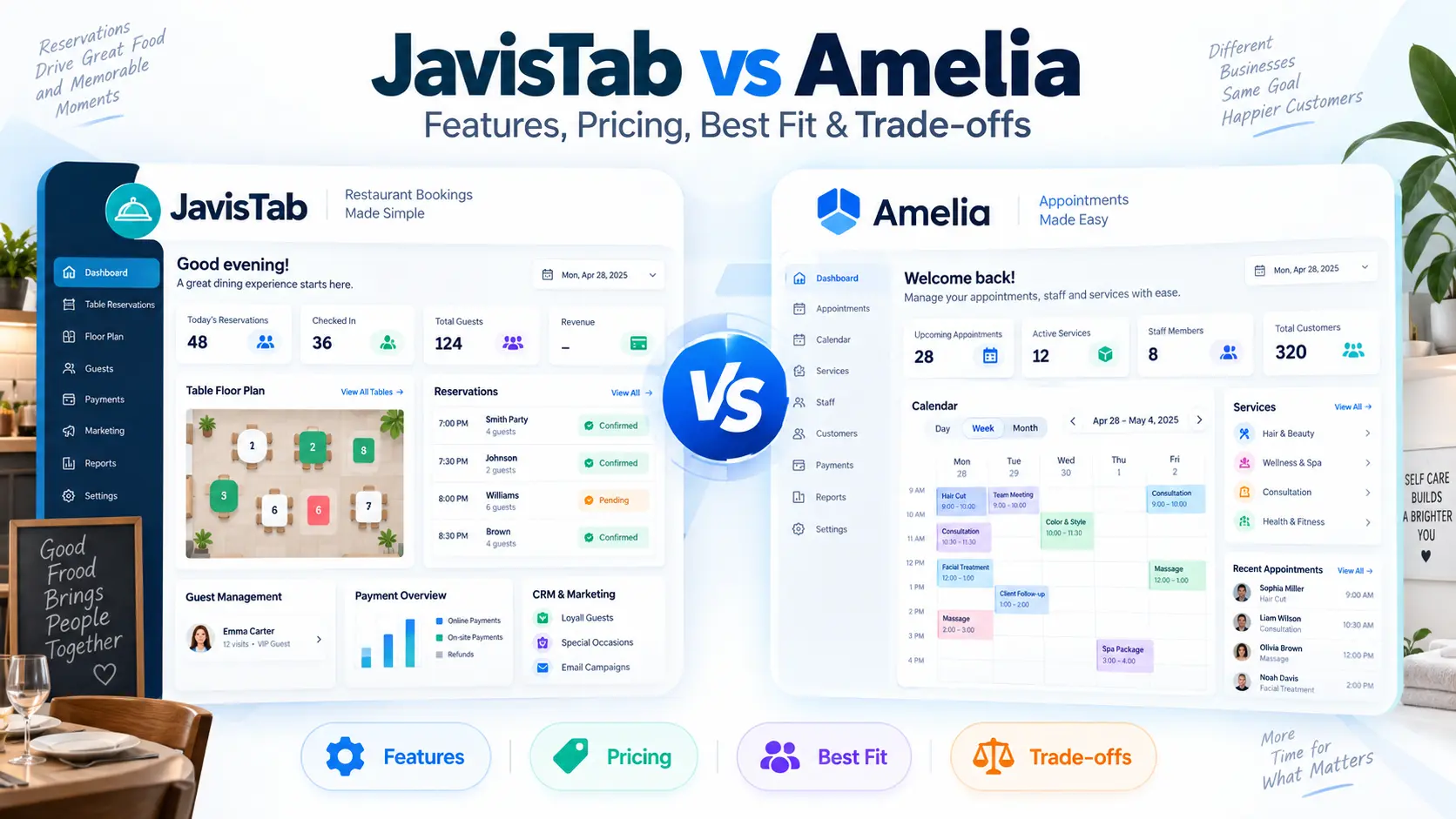
This comparison uses the supplied JavisTab Plugin source and official vendor pages checked 12 August 2026. It does not treat a marketing checkbox as operational proof. Prices and plan entitlements are volatile; verify checkout and documentation on the purchase date.
| Decision | JavisTab | Amelia |
| Primary center | Restaurant/hospitality reservations plus multi-industry flows | Employee-led appointments and events |
| Strongest differentiator | Tables/resources, restaurant party journey, localized payment options, CRM/loyalty in one WordPress plugin | Mature appointment/event catalog, recurring options, panels, calendars/meetings, broader documented integrations |
| Better first shortlist | Restaurants, cafés, spas needing hospitality context, multi-model operators, Vietnam-oriented payments | Salons, clinics, consultants, coaches, appointment teams, event-led businesses |
| Main proof needed | Documentation/plan alignment, exact non-restaurant depth, ecosystem integrations | Restaurant floor/table/turn workflow, selected tier, resource behavior |
Booking-flow architecture
JavisTab 6.7.8 defines presets for restaurant reservations, single appointments, group appointments, capacity classes, tours, hotel-stay compatibility, event packages, consultations, and custom flows. Presets adjust labels, step order, party mode, and interface defaults while sharing booking/payment engines.
Its restaurant journey is location, party size, date, time, package, details, payment, and confirmation. Single appointment uses location, service, staff, date, time, details, payment, confirmation. Group appointment adds party mode and guest-service selection. Class flow emphasizes class/date/time/participants and uses capacity as main inventory.
Amelia’s official product pages emphasize appointments and events. Services connect to employees and locations; customers can book recurring appointments, packages, group appointments, and events according to plan. This is a more mature mental model when staff calendars and service catalogs define availability.
Verdict: JavisTab offers more explicit industry journeys; Amelia has the stronger appointment/event specialization. Test the one high-volume path rather than valuing the number of presets.
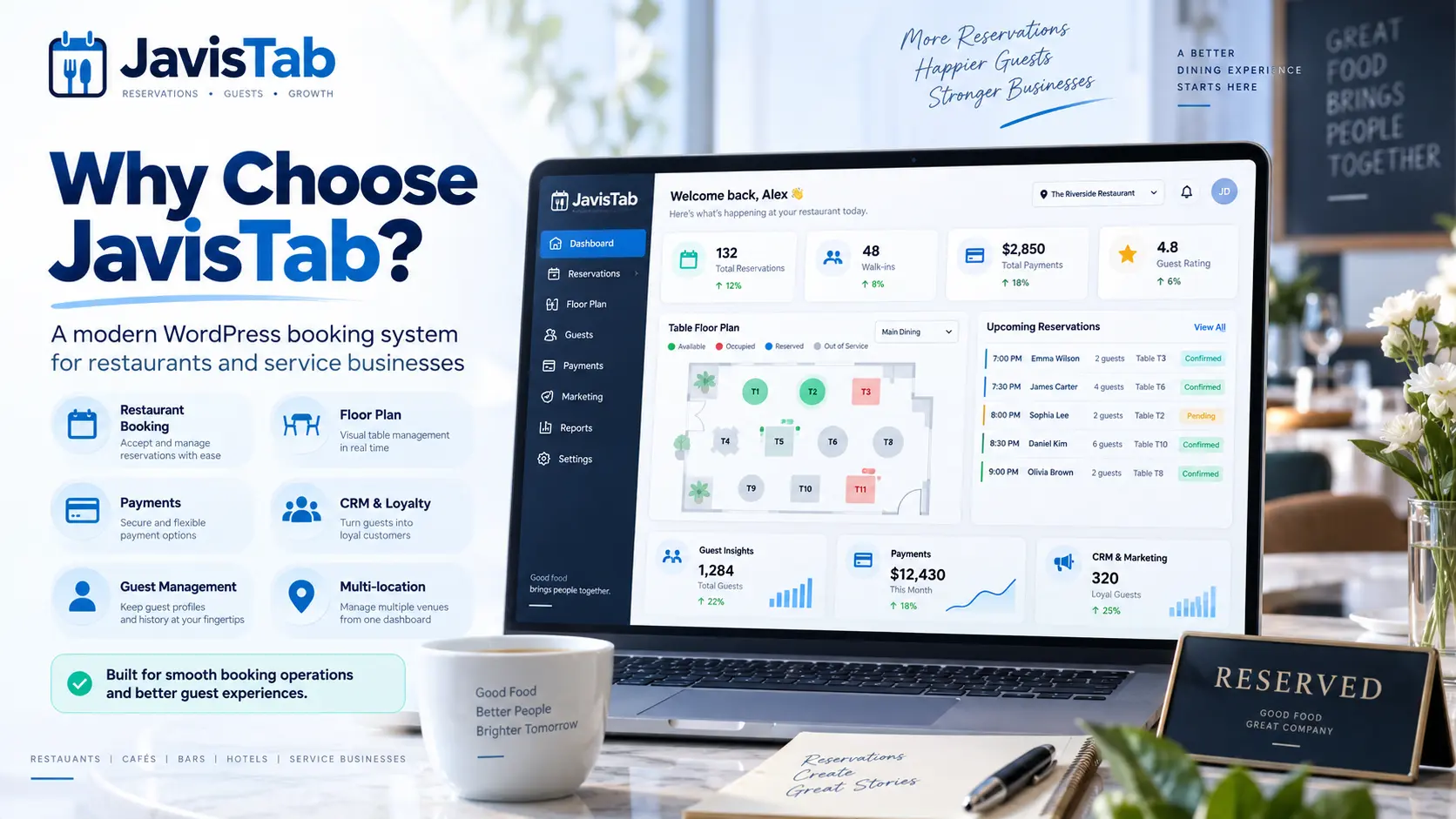
Restaurant tables, rooms, and resources
JavisTab is restaurant-native in the supplied build. Tables or resources, floors/rooms, party size, capacity modes, allocation/floor-plan views, dining status, and a guest-threshold deposit rule fit restaurant operations. The restaurant preset hides staff and appointment-service choices so guests see the decisions relevant to a table reservation.
Amelia documents resource management for limited assets such as rooms, equipment, cars, or chairs shared among employees. Resources can solve genuine appointment conflicts. A generic quantity resource is not automatically a restaurant floor plan: restaurants should prove table combinations, turn buffers, walk-ins, seating states, floor visibility, and host reassignment.
Verdict: JavisTab is the clearer choice for table-led restaurants. Amelia can fit room/equipment constraints around appointments, but a restaurant must validate the complete dining-room workflow.
Services, employees, groups, and recurrence
Both products support services and staff. JavisTab includes weekly schedules, off-days, service buffers, staff/service relationships, group guest-service choices, multi-service slot logic, and starter industry catalogs that are opt-in only when empty. Its group appointment source defaults to guest-first selection, parallel grouping, per-item pricing, and a default maximum of 10, within a wider form cap of 20.
Amelia’s official features and documentation describe unlimited or plan-appropriate employees/locations, service categories, custom duration, recurring appointments, packages, employee and customer panels, group appointments, extras, and resource management on eligible plans. Its product surface is designed around employee operations.
Verdict: Amelia has the more mature documented appointment stack, particularly for recurrence, employee panels, and appointment packages. JavisTab is credible for mixed hospitality and service use when the verified flow covers the exact scenario.
Classes and events
JavisTab’s class_capacity preset uses capacity as the main inventory, not a separate staff assignment per guest. It can support fitness and education scheduling, participants, services/classes, payment, and customer records. Its event/package flow can present bookable experiences, but the source should not be described as a full ticketing platform without proof.
Amelia explicitly markets appointments and events, including recurring events, ticket types or event tickets, waiting lists, packages, and QR/e-ticket features on eligible plans. That focus matters for public event pages and attendee operations.
Verdict: Amelia is better for event-led requirements and complex recurrence. JavisTab fits bounded classes or hospitality experiences where capacity, payment, and CRM are sufficient.
Payments and deposits
The supplied JavisTab 6.7.8 registry includes PayPal, Stripe, Square, Razorpay, OnePay, and bank transfer. Its booking engine supports pay at venue, deposit required, and prepaid. A restaurant can set a fixed base-currency deposit and guest threshold, including a conditional large-party deposit when ordinary payment is hidden. The source keeps secret credentials away from frontend JavaScript and validates provider callbacks according to gateway implementation.
Amelia’s official pricing/features pages list multiple payment methods by tier, including options such as Stripe, PayPal, Mollie, Razorpay, Square, WooCommerce, and others, plus deposit payments, payment links, refunds, taxes, and invoices on eligible plans. Amelia documents fixed or percentage deposits at the service/event/package level.
Verdict: Amelia provides broader documented international payment and item-level deposit flexibility. JavisTab stands out for restaurant party-threshold logic and Vietnam-oriented OnePay/bank-transfer or VietQR positioning. Provider onboarding and processing fees are separate in both.
CRM, loyalty, and marketing context
JavisTab customer records in 6.7.8 track visit count, no-show count, and total spent. Built-in segments include high spenders, frequent visitors, at-risk customers, new customers, and large-group bookers. Loyalty can add one point per guest. Booking history, notes, notifications, and review-funnel workflows create a hospitality-centered customer layer.
Amelia provides customer profiles/panels, booking history, packages, coupons, notifications, WhatsApp/SMS options by tier, webhooks, and marketing/automation integrations. Its value is a polished appointment customer journey and ecosystem rather than a restaurant-specific loyalty operating model.
Verdict: JavisTab has stronger built-in hospitality CRM/loyalty semantics. Amelia has broader appointment communication and integration paths. Advanced marketing automation should be verified in both rather than inferred from a customer list.
Calendars, meetings, and integrations
JavisTab includes Google Calendar and ICS-related behavior, REST routes, form adapters, gateway callbacks, and integration modules in the supplied source. Its REST API exposes public availability/services/staff reads and form-facing endpoints, while protected management actions require WordPress permissions and nonces. Plan entitlement may gate API use.
Amelia officially documents Google, Outlook, and Apple calendar synchronization, Zoom/meeting tools, WooCommerce, Elementor/Divi, BuddyBoss, analytics, webhooks, and REST API at eligible tiers. Its general WordPress service-business ecosystem is broader and more visible.
Verdict: Amelia is preferable when named calendar, meeting, page-builder, and community integrations are non-negotiable. JavisTab is suitable when Google/ICS and its specific WordPress/POS/API path are enough; prove every required endpoint.
Multi-location, language, and currency
JavisTab uses location-aware flows and branch-scoped concepts in source, with multilingual catalogs, booking-language persistence, and multi-currency controls. The supplied build contains 13 translation catalogs. Test branch-specific hours, timezone, capacity, services, payment profile, and messages.
Amelia markets unlimited locations on appropriate paid tiers, employee-location relationships, multilingual support, time-zone behavior, and international payment/currency workflows. Its appointment-first interface can be easier for distributed staff teams.
Verdict: Both can support locations and multilingual booking. JavisTab better reflects hospitality branches; Amelia better reflects employees across appointment locations. Neither claim replaces cross-location isolation testing.
Privacy, security, and data ownership
Both are WordPress plugins, so site owners control hosting and carry responsibility for updates, backups, access, retention, email, and incident response. JavisTab 6.7.8 registers WordPress personal-data exporter/eraser hooks and suggested privacy content. Its REST management routes use capability checks, while booking submission uses a nonce and rate limiting in source.
Amelia documents GDPR-oriented features and WordPress deployment. Buyers should inspect current exporter/eraser behavior, roles, retention, logs, processors, and plan-specific APIs. Clinics must assess health-data requirements separately; no booking-plugin label establishes regulatory compliance.
Verdict: Both support WordPress data ownership, which is an obligation as well as a benefit. Choose based on proven controls and the team’s ability to maintain the site.
Pricing comparison—checked 12 August 2026
JavisTab’s official pricing page listed a Free/trial route plus Starter $19.90/30 days, Professional $39.90/90 days, Business $59.90/180 days, and Annual $99.90/365 days. Paid offers generally stated three sites. The page also displayed a limited Professional promotion, a 30-day refund statement, and tier gates for API, waitlist, white label, and multi-restaurant features.
Amelia’s official pricing page offered a limited free version, annual and lifetime families, four annual tiers (Starter, Standard, Pro, Elite), a 15-day money-back guarantee, and first-year promotions. Its dynamic cards were not consistently readable in extraction; stable visible promotional “starting from” figures included annual Pro $149 and Elite $259, and lifetime Standard $299, Pro $349, and Elite $709. Amelia’s own current comparison content separately lists regular annual/lifetime figures, illustrating why buyers must confirm the live cart, domain allowance, tax, and entitlement.
| Cost dimension | JavisTab | Amelia |
| Free entry | Free/trial route shown; core and advanced entitlements vary | Limited free version; paid features/tier matrix applies |
| Paid model | Fixed terms of 30, 90, 180, or 365 days; current paid offers state three sites | Annual subscriptions and lifetime licenses; domain allowances vary |
| Add-on structure | Official positioning emphasizes bundled features, but plan gates remain | Official page emphasizes tier bundles without hidden add-ons; features move by tier |
| Ongoing costs | Hosting, provider fees, SMS/email, maintenance, renewal/support | Same, plus selected annual/lifetime tier and any provider/integration charges |
Do not compare JavisTab’s 30-day price with Amelia’s annual or lifetime sticker. Normalize three years, required domains, exact features, support/update period, implementation, gateways, messages, hosting, and internal maintenance.
Migration and implementation effort
JavisTab’s restaurant-first setup may be faster when the source data is floors, tables, service periods, packages, and guest history. Amelia may be faster when the source data is employees, services, recurring appointments, events, and external calendars. In either direction, migration requires field mapping, duplicate handling, future-booking reconciliation, consent review, and a cutover window; installing the plugin does not translate another product’s resource semantics.
Budget a production-like pilot, staff training, transactional-email authentication, gateway/webhook setup, cache exclusions, backups, and post-launch monitoring. Test a rollback that preserves bookings created after deployment. Implementation cost can outweigh the first license year, so include it in the comparison instead of calling setup “free” because an administrator performs it.
Use one implementation owner and one operational owner. The implementation owner controls staging, data mapping, security, cache, payment, deployment, and rollback. The operational owner controls schedules, catalogs, locations, policies, staff training, and exceptions. Require both to sign off on the acceptance results; a technically successful launch can still fail daily operations, and a pleasant workflow can still have unsafe payment or permission behavior.
Best fit by business
Choose JavisTab when
- Tables, floors/rooms, party size, restaurant status, waitlist, or hospitality packages define the main workflow.
- The business wants a fixed large-party deposit threshold and pay-at-venue/prepaid options.
- OnePay, bank transfer/VietQR, or Vietnam-oriented operations are important.
- Booking, hospitality CRM, loyalty, payment, and several industry flows should remain in one WordPress-centered system.
- The team accepts a smaller ecosystem and will validate plan/documentation alignment.
Choose Amelia when
- Employee-led appointments, recurring services, packages, resources, and staff/customer panels are central.
- Events, tickets, waiting lists, or recurring event operations matter.
- Outlook/Apple calendars, meetings, WooCommerce, page builders, BuddyBoss, or broad documented integrations are required.
- A mature appointment product, larger knowledge base, and agency licensing path matter more than restaurant-floor semantics.
- The required capabilities are confirmed in the selected annual or lifetime tier.
Trade-offs
JavisTab’s breadth and hospitality focus can reduce the need for separate booking, customer, loyalty, and payment plugins. The trade-off is a smaller third-party ecosystem and public documentation that may not perfectly track the supplied code. Disable irrelevant modules and test the narrower flow.
Amelia’s depth, panels, events, and integrations make it a safer default for many appointment businesses. Its tier matrix and richer configuration require careful entitlement and workflow review. Restaurant buyers may need to adapt generic resources into a seating process that is less native.
Seven identical tests before choosing
- Create the highest-volume booking plus two difficult exceptions.
- Race two browsers for the final staff/resource/table slot.
- Complete a deposit, failed payment, retry, duplicate callback, cancellation, and refund.
- Change staff/resource/location and verify every calendar event and message.
- Ask a frontline user to complete daily operations without developer help.
- Export/erase a test customer, inspect roles/logs, and rehearse backup/rollback.
- Calculate a three-year bill with current plan, domains, providers, messages, support, and implementation.
Frequently asked questions
Is JavisTab better than Amelia for restaurants?
Usually it is the more restaurant-native shortlist because its supplied source includes tables/resources, party size, floor/allocation concepts, restaurant statuses, and threshold deposits. Amelia can model limited resources around appointments, but restaurants should prove turns, table combinations, walk-ins, and host workflow before choosing it.
Is Amelia better for spas and salons?
Amelia has deeper documented appointment, recurrence, employee/customer panel, event, calendar, and integration capabilities. JavisTab 6.7.8 also has a group-appointment spa/salon flow, multi-service behavior, payments, CRM, and loyalty. Choose from the actual services, staff, rooms, packages, and integrations—not category labels.
Which has better pricing?
JavisTab’s published term prices are lower in sticker value than Amelia’s visible paid-plan figures, but durations, domains, tier entitlements, support, promotions, and lifetime options differ. Normalize a three-year production configuration and confirm both live carts on the purchase date.
Do both support deposits?
Yes, but with different strengths. JavisTab’s verified restaurant rule uses a fixed amount triggered by guest count and can appear conditionally. Amelia documents fixed and percentage deposits for catalog items on eligible plans. Test amount, balance, cancellation, refund, and gateway recovery.
Does JavisTab have a REST API?
The 6.7.8 source registers an rbp/v1 REST namespace with availability, timeslots, packages, services, staff, bookings, payment, and protected management routes. This is not unrestricted anonymous administration; nonces, capabilities, rate limits, and plan entitlements apply.
Can I migrate between them later?
Plan for export before launch. Both live in WordPress, but schemas and workflow semantics differ. Test customer and future-booking export, stable IDs, consent, payment references, attachments/notes, and a cutover plan. WordPress ownership does not make migrations automatic.
NEUTRAL VERDICT JavisTab wins for restaurant/hospitality semantics and a compact all-in-one WordPress stack; Amelia wins for appointment/event depth and integration breadth. The better product is the one that passes the business’s two most expensive failure cases in the exact paid tier.
Related articles
How to Set Up a Restaurant Reservation System on WordPress
What a restaurant reservation system must control A restaurant reservation system is more than a calendar. It decides whether a…
Best WordPress Restaurant Booking Plugin 2026: 7 Options Compared

Running restaurant reservations through phone calls, direct messages, spreadsheets, and handwritten notes may work when a venue is quiet. It…
How to Create an Appointment Scheduling Website That Converts | JavisTab
Your website should be your hardest-working employee—booking appointments around the clock without breaks, sick days, or overtime. Yet most service…
Online Payment for Bookings: Complete Integration Guide 2026 | JavisTab
Taking payment at the time of booking isn't just convenient—it's transformational. Businesses that require prepayment or deposits see no-show rates…